A colleague astonished me yesterday by asking, “What’s the deal with that red flower?” She wanted to know why Prince William, Kate Middleton, and so many other Brits wore poppies on their lapels at the annual National Service of Remembrance at the Cenotaph in London.
I found her question as surprisingly clueless as asking, “What’s the deal with that pink ribbon?” You know, the one people wear in October to raise awareness for breast cancer.
For those who have no clue, people wear the poppy from late October to mid-November to honor those who died in World War I. The armistice to end that war was signed at the 11th hour of the 11th day of the 11th month in 1918. Hence, 11/11 is observed as Remembrance Day (or Armistice Day).
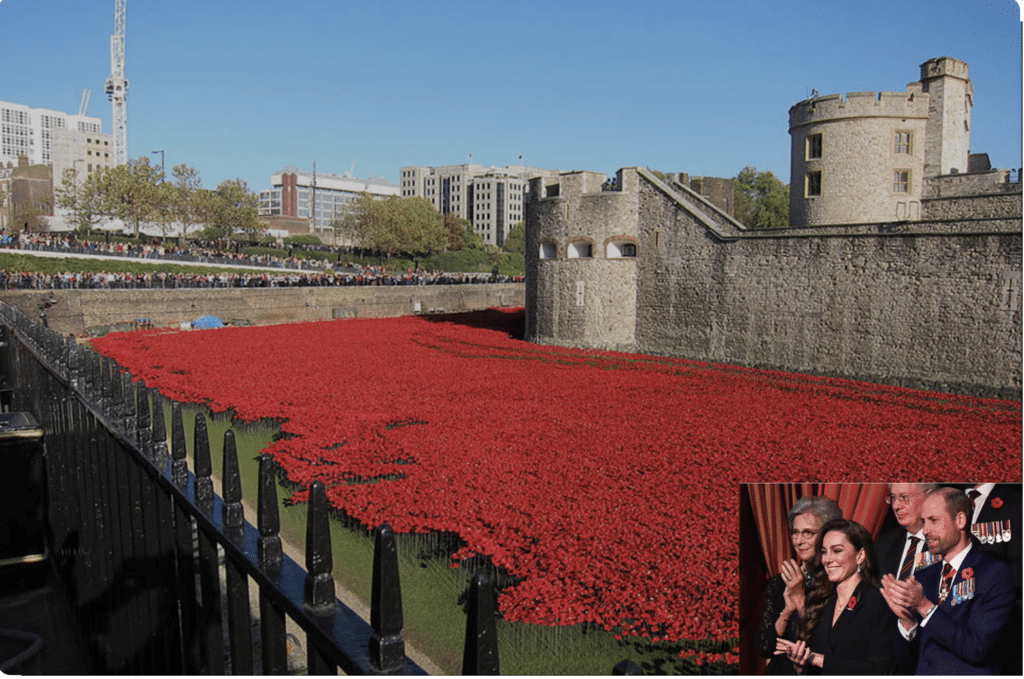
The British prefer Remembrance Sunday, even if it falls on the 9th instead of the 11th. By contrast, Americans always mark the 11th, come what day. In 1954, the US renamed it Veterans Day, expanding the tribute to all veterans, living and dead, who served in wars since — from Vietnam to Iraq and Afghanistan.
Naturally, we thank all veterans for their service. But Black soldiers who fought heroically in both World Wars deserve special mention. After all, nothing could have been more humbling — or humiliating — than fighting in Europe to “make the world safe for democracy,” only to return to an America still neither safe nor democratic for Black folks.
The famous poem “In Flanders Fields” was inspired by the death of a soldier in WWI. Over time, it evolved into an elegy for all war dead. My primary school teacher made us recite it with the same reverence my Sunday school teacher reserved for “The Lord’s Prayer.”
IN FLANDERS FIELDS
In Flanders fields the poppies blow
Between the crosses, row on row,
That mark our place: and in the sky
The larks, still bravely singing, fly
Scarce heard amid the guns below.
We are the dead. Short days ago
We lived, felt dawn, saw sunset glow,
Loved and were loved, and now we lie
In Flanders fields.
Take up our quarrel with the foe;
To you from failing hands we throw
The torch; be yours to hold it high,
If ye break faith with us who die
We shall not sleep, though poppies grow
In Flanders fields.
(John McCrae, 1915)
The cultural presumption this poem imbued explains my astonishment at my colleague’s ignorance. Never mind that I now struggle to recite this poem, which says as much about my encroaching senility as my evolving cynicism.
NOTE: iPINIONS first published this commentary in 2011 and reprise it each year — with updated photos — to honor the fallen and commend the UK’s awe-inspiring tributes. They remain poignant reminders of the “Blood Swept Lands and Seas of Red” that define all wars.
Legacy Note: With over 5,600 posts spanning 20 years, I am easily the most prolific blogger on the most eclectic array of topics on the web. That makes The iPINIONS Journal an unparalleled archive of informed political and cultural commentary. Visit the ARCHIVES section in the sidebar or search by topic. You won’t find a more consistent, independent voice on world affairs.